Sunday, 13 March 2016


Friday, 11 March 2016
St Pauls Cathedral
After singing the praises of humble structures in my last blog, this post pays homage to a building which was designed and built specifically to impress; St Pauls Cathedral.


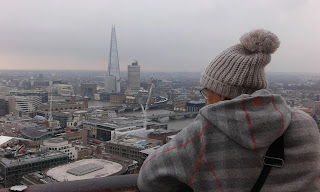 There are 526 steps to climb if you want to get to the 'Golden Gallery', which is up above the dome. I have been here before. I was 12 years old, and I climbed all the way up with my mum. It is very special for me to return now, and share this place with my daughter. Maybe one day, some of you will stand here too.

The earthquakes in Christchurch have damaged the cathedral there beyond repair.

This is a model of the original
St Pauls Cathedral. It was destroyed in the
Great Fire of London.


As I look at the London skyline, my eye is always drawn to the magnificent dome of St Pauls. From a distance, or close up, it is a beautiful building. The word 'awesome' is used a lot today, but it was originally intended to describe sights like this.


The earthquakes in Christchurch have damaged the cathedral there beyond repair.

St Pauls Cathedral. It was destroyed in the
Great Fire of London.
But look what stands there now.


Thursday, 10 March 2016
Man Made
Something that always interests and amazes me in Britain is the incredible array of engineering that you see everywhere. Sure, there are castles and stately homes, but I am fascinated by structures like bridges, embankments, walls, tunnels, aquaducts and canals. In New Zealand our surrounding environment tends to be predominantly natural. Here in the UK, every inch of the environment seems to be man made.
The canals are one of these incredible man made structures. Before trains, cars and trucks, goods were transported around the country via the canals. Now, they are maintained more for leisure, and for their historical significance.
Each section of canal is level, and so to get up and down across the country, there are locks.
A boat enters the lock; the water fills up or empties out in the lock, depending on whether you are travelling uphill or down; the lock opens and the boat carries on along the next section of canal.


The canals are one of these incredible man made structures. Before trains, cars and trucks, goods were transported around the country via the canals. Now, they are maintained more for leisure, and for their historical significance.
Each section of canal is level, and so to get up and down across the country, there are locks.
A boat enters the lock; the water fills up or empties out in the lock, depending on whether you are travelling uphill or down; the lock opens and the boat carries on along the next section of canal.


Many people live on canal boats, or narrowboats as they are called. Some don't look like they travel far any more. Living on a canal boat is inexpensive accommodation in England.
Tuesday, 8 March 2016
Squirrel!!!
As I was walking to the station, I spotted a squirrel.
New Zealand is a land of birds; we only have one native land mammal (Do you know what species it is?) I thought the students at TAI would probably be interested to see a squirrel, as we don't have them in New Zealand. I decided to video, and was delighted to watch him actually bury an acorn.
In the forests of Europe, animals like the squirrel forget where they have stashed acorns, nuts and seeds. Consequently, these buried treasures sprout and become big trees.
Monday, 7 March 2016
Undergound
Jay and I were out and about in London today, doing some shopping in Stratford, then meeting my nephew for dinner at his flat in West Hampstead.


Finding your way around London on 'the tube' is an exercise in problem solving, and it is quite fun
For example, to get from Stratford to West Hampstead you could travel westbound on the Central Line change to the Jubilee Line at Bond Street, travel northbound 5 stops to West Hampstead. Could we have gone a different way?


Clicking on this link will take you to a PDF map of the London Underground
content.tfl.gov.uk › standard-tube-map
Navigate your way around these journeys:
1. Jay lives close to Hackney Downs station. She travels to work, near Blackfriars. What route should she take?
2. Jay's friend Haily lives in East Putney. They decide to meet at Green Park tube station and do some sightseeing at Buckingham Palace. How could Haily get to Green Park?
3. How would Jay get to Green Park from home?
4. How would Jay get to Green Park from work?
Saturday, 5 March 2016
Being Icelandic
- Icelandic children firstly speak, read and write in Icelandic. At about 5 or 6 years of age, they will begin to learn their second language; English. At around 10 years of age they will start to learn Danish. At secondary school they will begin to study a 4th language, usually either French or German.

- It is compulsory in Iceland to learn to swim and it is a curriculum requirement in schools. Every village or town has at least one thermally heated swimming pool. This facility will include hot tubs, and many houses have a hot tub in their yard. Swimming for Icelandic people is a social activity. Most people will swim at least once or twice a week. People gather with friends and family at a pool or hot tub in the same way that other cultures go to the pub or meet for a drink.
 3. 'Freedom to Roam', is a customary right in Iceland. This means that anybody can walk over any piece of land without needing to gain permission. The only exception is crossing cultivated land, for example across a crop or ploughed field, but you can still walk around that.


Thursday, 3 March 2016
Land of Fire and Ice
Like New Zealand, Iceland is located right across the junction of two tectonic plates. New Zealand has been formed as a result of the two plates (the Indo -Australian and the Pacific) pushing together, forming mountains like the Southern Alps as the edges buckle and collide. Iceland straddles the edge of the American and the Eurasian plates, however, the two plates are ripping apart at a rate of approximately two centimetres a year. As a result, instead of a mountain range, a 'rift valley' occurs.
 |
| The American plate is on my right. Cracks and fissures appear along its edge. |
Both countries experience frequent earthquakes and eruptions at volcanic hotspots. Mix the hot lava with water, and you get geothermal activity, just like Rotorua.
The geothermal activity provides hot water and energy in abundance for Iceland. All homes in Iceland have cheap geothermal hot water and heating. Some footpaths have hot water pipes underneath to keep them clear of snow.
 |
| Bananas are grown in this town... |
 |
| in glass houses like this, heated with geothermal water from the ground. |
We were also very lucky, and excited, to see the Northern Lights last night. They are best seen in the darker winter months around the Arctic Circle. We saw them at midnight. It was -9 standing out in the snow watching them.

Subscribe to:
Posts (Atom)